8. Textbooks, References and Resources

(from The Learning and Teaching of Slavic Languages.
Edited by Olga Kagan and Benjamin Rifkin. Bloomington, IN: Slavica, 2000, pp. 681--94[!])


Resources for Teachers of Russian

Karen E. Robblee

© 2000 by Karen E. Robblee. All rights reserved.

0. Introduction

Since 1984, when Parrott published his article "Updating that Reference Shelf", tremendous changes have taken place in the former Soviet Union. As Benson (1995) observed, the developments of the post-Soviet era have had a profound effect on the Russian language, especially on the lexicon.

While many of the references mentioned by Parrott remain essential for a teacher of Russian, the linguistic developments in Russian suggest that it is time to update once more. Many new and revised publications on the Russian language are now available. Unfortunately for language instructors, materials published in the former Soviet Union are no longer as inexpensive as they once were.

This article uses Parrott as a point of departure, focusing on materials that have become available in the last fifteen years. For more comprehensive information about the resources available, readers should also refer to Parrott.

1. General Dictionaries

All Russian language teachers should have access to a multi-volume monolingual dictionary. In 1981--84 the Russian Language Institute of the Academy of Sciences published a second (revised) edition of the Slovar' russkogo jazyka v chetyrex tomax. The new edition includes vocabulary introduced into the lexicon in the 1960s and 1970s. Like its predecessors’, this dictionary’s main advantages are its comprehensiveness, numerous literary examples, and general affordability. More recently, the Russian Language Institute has begun to release the 20-volume Slovar' sovremennogo russkogo literaturnogo jazyka (2nd edition, 1991--) edited by Gorbachevich. While a twenty-volume dictionary would normally be an exorbitant purchase on the average language teacher’s salary, many instructors may find this dictionary affordable since the volumes can be paid for individually as they become available.

In 1992, Ozhegov’s single volume Slovar' russkogo jazyka was renamed Tolkovyj slovar' russkogo jazyka, and Shvedova has become a co-compiler. The Ozhegov-Shvedova volume is less prescriptive than its predecessors and contains approximately 72,500 entries. It is the most important single-volume dictionary for an instructor to own. Teachers who recommend this dictionary to their advanced language students should spend a few minutes of class time showing them how to use the grammatical information it contains.

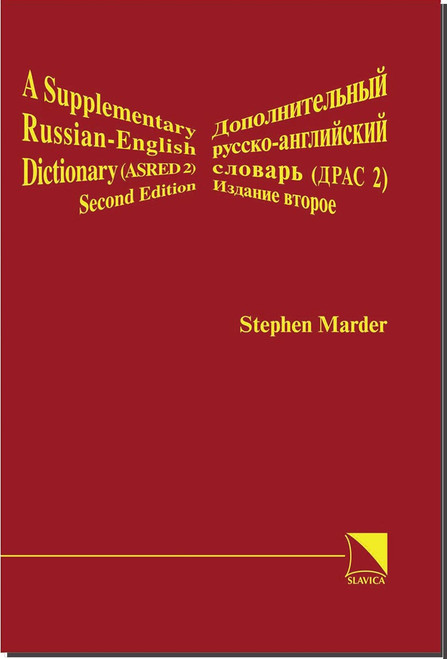
Marder’s A Supplementary Russian-English Dictionary (1992) contains approximately 29,000 entries and was conceived as a supplement to the two most widely used Russian-English dictionaries, Wheeler’s Oxford Russian-English Dictionary and Smirnitsky’s Russian-English Dictionary. It focuses on words that have entered the language in recent years, including from the areas of politics and technology. Wheeler’s Oxford Russian-English Dictionary underwent minor revision in 1984. Galperin’s two-volume Bol'shoj anglo-russkij slovar' was also revised and supplemented in 1987. It remains the most comprehensive English-Russian dictionary available. Falla’s Oxford English-Russian Dictionary was first published in 1984, and a corrected edition was printed in 1987. Like its counterpart, the Oxford Russian-English Dictionary, Falla’s dictionary is now available in paperback.

Previously there was no comprehensive single volume Russian-English/English-Russian dictionary, but now there are two. Katzner’s was published in 1984, and it was revised and expanded in 1994. Since Katzner’s dictionary is based on American usage and is available in soft cover, some students find it especially appealing. The Oxford Russian Dictionary, published in 1993, combines and updates the Wheeler and Falla dictionaries in a single volume. It also provides the IPA transcription of English, which is useful for exchange teachers from Russian teaching in English-speaking universities.

2. Idioms, Phraseology, and Slang

The Random House Russian-English Dictionary of Idioms compiled by Lubensky (1995) is the most valuable bilingual reference on idioms and collocations. It presents some 13,000 expressions in nearly 6,900 entries, and includes many literary examples. Blenjanin and Bjutenko have published a Tolkovyj slovar' sovremennyx razgovornyx frazeologizmov i prislovij (1993); and Benson and Benson have compiled a Russian-English Dictionary of Verbal Collocations (1993).

Three books describing collocations relating to the human body have been published. Monohan’s A Dictionary of Russian Gesture was published in 1983. In 1991, Russkij jazyk published Akishina’s monolingual Zhesty i mimika v russkoj rechi, and in 1996 Slavica published Iordanskaja and Paperno’s A Russian-English Collocational Dictionary of the Human Body.[1]

Dictionaries of slang have become more widely available. They include Slovar' moskovskogo argo, compiled by Èlistratov (1994), and Russkij zhargon 60--90-x godov, compiled by Juganov and Juganova (1994). The Dictionary of Russian Slang and Colloquial Expressions (1995) compiled by Shlyakhov and Adler is aimed at the English speaker and contains approximately 4,500 entries.

At one time Slavists may not have needed to include a book on obscenities in a basic reference collection. But the reduction in Russian censorship has led to the inclusion of more linguistic registers in mainstream publications and films, thus making such a reference essential. In addition to the well known A Short Dictionary of Russian Obscenities, several new compilations of Russian obscenities have become available. They include Maxov’s Slovar' blatnogo zhargona v SSSR (1991), as well as Baldaev’s Slovar' tjuremno-lagerno-blatnogo zhargona (1992). The general purpose dictionaries on idioms and slang discussed above also contain new information of this nature.

3. Colloquial Language

Zemskaja’s group has published several new volumes on Colloquial Russian. They include Russkaja razgovornaja rech': Fonetika, Morfologija, Leksika, Zhest (1983), Gorodskoe prostorechie (1984), and Russkaja razgovornaja rech': lingvisticheskij analyz i problemy obuchenija (1987). The 1983 volume contains an interesting section on Russian wordplay; the 1984 volume contains exercises and materials that may be suitable for advanced language classes. Yokoyama’s Discourse and Word Order (1986) is an important source on word order.

4. References on "C"ulture and "c"ulture

A basic reference shelf should include a dictionary of Russian proverbs. Zhukov’s Slovar' russkix poslovic i pogovorok (5th ed., 1993) is a useful volume, with approximately 1,200 entries.

Gerhart’s The Russian’s World: Life and Languages has been thoroughly revised. The book contains six new chapters. Much of the information presented by Gerhart is difficult to find in other sources. Her book includes five broad sections on culturally appropriate behavior, perspectives on the individual, home, community, and the world. Gerhart discusses topics including sanitation, sex ("o chem ne govorjat"), names for pets, children’s games, mathematical expressions, medicinal plants, holidays and the church. The appendix contains information such as suggestions for those in business, Peter the Great’s Table of Ranks, the Morse code, and Braille. Gerhart also provides extensive coverage on nature (including plants, animals, and birds). Since the book is written in English, with terminology and relevant excerpts in Russian, instructors can easily incorporate this book into elementary language classes. In contrast, Nemirovskaya’s Inside the Russian Soul: A Historical Survey of Russian Cultural Patterns (1997) is designed to serve as the basis of an advanced language course on Russian cultural history. Gerhart and Nemirovskaya both attempt to describe their subject matter from a Russian perspective. While Gerhart focuses on the culture of everyday life, Nemirovskaya’s emphasis is on high culture and history.

Because of increased contact between Russia and the west, as well as a growing emphasis on communicative language instruction, questions of etiquette have become increasingly relevant to the language classroom. (Students are more likely to have personal contact with Russians–in fact, many of them have already met Russians through high school exchange programs or have traveled to Russia. Akishina and Formanovskaja’s (1975) Russkij rechevoj ètiket remains the best source available on the etiquette of spoken Russian. Additional information about the spoken language is presented in Formanovskaja’s (1984) Upotreblenie russkogo rechevogo ètiketa (2nd ed.) and in Zemskaja (1987). Akishina and Formanovskaja address the etiquette of letter writing in their 1983 volume Ètiket russkogo pis'ma.

Food plays such a central role in culture that instructors might also want to have a few Russian cookbooks on hand. English language cookbooks such as Toomre’s 1992 translation of Molohovets’ Classic Russian Cooking: A Gift to Young Housewives, can serve as a resource for students of all levels.

5. Business Russian

In 1984, few American institutions offered courses on Business Russian, but interest in this topic has grown. Since 1990, the American Association of Teachers of Slavic and East European Languages has included a panel on Business Russian at its annual meeting. Instructors who are developing courses in Business Russian need both dictionaries and textbooks. Zagorskaja’s (1997) Bol'shoj Anglo-russkij russko-anglijskij slovar' po biznesu is a valuable resource containing over 18,000 entries. Business terminology and etiquette is addressed in the first appendix to Gerhart’s The Russian’s World. Two textbooks from the late Soviet period that still provide valuable information are Demidova and Smirnov’s (1985) Russkaja kommercheskaja korrespondencija and Kohls’ recently updated (1994) Business Russian: A reference and textbook. Both of these books are best used in combination with other materials.

Two recently published books are comprehensive enough to be used by themselves for a Business Russian class on the third- or fourth- year level. Russkij jazyk v delovom obshchenii by Klobukova et al. (1997) covers business vocabulary and expressions, dialogues and correspondence. Expressions are presented in a way that helps students review and strengthen their knowledge of grammar. Except for the glossary and short translation exercises, the book is entirely in Russian, but the material is accessible to a third- or fourth- year student. At the same time, the book could be used in combination with other materials for a more advanced course.

Nyusya Milman’s Business Russian: A Cultural Approach (1996) offers a general background in high and everyday culture in the course of teaching about business, and its dialogues and vocabulary reflect this breadth. The book also contains readings about the history of business in Russia and its practice today. Like Klubokova’s book, Business Russian is intended for intermediate or advanced students and is entirely in Russian. Each unit includes Voprosy dlja obsuzhdenija, asking students to reflect on and make conclusions about the book’s dialogues, which address cultural differences and issues of appropriate behavior that arise between Russians and non-Russians. The textbook is accompanied by a videotape, so that information on non-verbal behavior is also provided. Because this book focuses on the open-ended topic of culture, and because it provides so many opportunities for discussion, it could be used for classes for the third- or fourth- year level. A supplemental CD-ROM has recently been published by the University of Michigan Press.

6. Aids for Selecting Lexical Materials

Several new sources may be of service to a teacher who is deciding what vocabulary to include in the curriculum. In 1985 Morkovkin’s Leksicheskie minimumy sovremenngo russkogo jazyka was published. It was followed by Gabuchan’s (1988) Uchebnyj tolkovyj slovar' russkogo jazyka. Gabuchan’s dictionary contains almost 3,500 entries that were selected based on their high frequency and their typical inclusion in Russian language textbooks. Since one of its main objectives is to teach students to use a monolingual dictionary, all entries are defined only in terms of each other. Sajaxova and Xasanova’s (1989) Illjustrirovannyj tematicheskij slovar' russkogo jazyka provides vocabulary and illustrations on over 40 topics under the general rubrics of "man", "society," "nature", and "time, space and quantity." The Chastotnyi slovar' sovremennogo russkogo jazyka edited by Lönngren (1993), is a frequency dictionary with one million items. It is representative of more genres than its predecessors (e.g., Shanskij 1982). But Lönngren’s dictionary does not include definitions and, like its predecessors, is based only on written sources. None of the frequency dictionaries available focus on spoken Russian.

Rogozhnikova’s (1991) Slovar' èkvivalentov slova focuses on adverbial, auxiliary and modal expressions, which are particularly useful both to students learning to form complex sentences and for teachers who are developing materials for the intermediate and advanced levels. Vishnjakova’s (1984) Slovar' paronimov russkogo jazyka presents nearly 1,000 pairs of etymologically related words that differ in meaning, providing information about their phraseological and combinatory patterns (e.g., dramaticheskij kruzhok but dramatichnyj vyxod). Vishnjakova’s Paronimy sovremennogo russkogo jazyka (2nd edition, 1987) contains exercises as well as explanations. Èl'janov’s Kavernye udarenija: Russko-anglijskij slovar' omografov (1995) contains an alphabetical listing of homographs and their English translations, as well as an appendix of words common to Russian and English.

7. Other Specialized Dictionaries

An abundance of other specialized dictionaries are useful for occasional reference. Bernshtein et al. (1995) have compiled the Novyj slovar' sokrashchenij russkogo jazyka, with almost 32,000 entries. Gorskaja’s Anglo-russkij-Russko-anglijskij slovar' geograficheskix nazvanij (2nd edition, 1994) contains 6,000 geographical terms in use as of January 1, 1991. [2] This is a handy reference when discussing travel, genealogy, or student coursework in other classes.

Borunova’s Orfoèpicheskij slovar' russkogo jazyka (1983) is a convenient tool for checking word stress and the pronunciation of foreign borrowings and consonant clusters.[3] Barxudarov’s (1987) Orfograficheskij slovar' russkogo jazyka is an aid for checking spelling. It has separate entries for participial forms that other dictionaries may list only under the verb. [4] Zaliznjak’s Grammaticheskij slovar' russkogo jazyka (1987) is a reverse dictionary, in which words are alphabetized according to the end of the word. As a result, all infinitives in -at' are grouped together, as are all adjectives in -oj. This dictionary can facilitate a quick response to student queries about the frequency of some morphological patterns. It can also assist the instructor in selecting items to be included in morphological exercises.[5] Sazonova’s (1989) Russkij glagol i ego prichastnye formy contains entries for 2500 verbs, providing extensive information about their forms and meanings. For instance, Sazonova indicates that the verb reshit' has seven meanings, only some of which may be used with long-form past passive participles.[6] Rozental' and Telenkova’s (1985) Slovar' trudnostej russkogo jazyka is a handy reference addressing problems of orthography, punctuation, pronunciation, and the grammatical properties of individual words. A new edition of Benson’s Dictionary of Russian Personal Names, providing information on the stress and morphology of names, was published in 1992.

With the increasing use of instructional technologies and the World Wide Web in Russian language instruction, a Russian teacher’s reference collection should include a dictionary of computer terminology. Orlov’s (1998) Sovremennyj anglo-russkij slovar' po vychislitel'noj texnike is a comprehensive reference for computer terminology terms.

8. Grammars

Unbegaun’s (1957) Russian Grammar and Borras and Christian’s (1971) Russian Syntax: Aspects of Modern Russian Syntax and Vocabulary remain standard references. Unbegaun describes the main issues of Russian morphology and syntax, while Borras and Christian go into greater detail on syntax and usage.[7] Wade’s (1992) A Comprehensive Russian Grammar presents a highly detailed and well-indexed exposition of Russian grammar. Offord’s (1996) Using Russian: A Guide to Contemporary Usage is an attractive volume with sections on a broad range of topics that pose difficulties for the native speaker of English. These include homonyms, false friends and idioms, verbal etiquette, and problems of translation. Offord also includes a chapter describing the main dialects and registers of contemporary Russian. Boguslavensky’s (1981) Russian Review Grammar presents comprehensive reviews of each morphological case, including extensive information on verb government. The chapter on time expressions is particularly useful.

Some instructors recommend Pexlivanova and Lebedeva’s (1988) Grammatika russkogo jazyka v illjustracijax to those who are teaching for the first time. This grammar contains simple and concise explanations aimed at the elementary and intermediate levels. The grammar anticipates many of the difficult issues that come up in first-year Russian (e.g., usage of the conjunctions tozhe vs. takzhe, and a vs. no), and the illustrated explanations may be used to develop accessible grammar presentations in Russian rather than English.

Rassudova’s book on Russian aspect has been revised and translated into English under the title Aspectual Usage in Modern Russian (1984). Her book and Forsyth’s (1970) A Grammar of Aspect remain the most comprehensive references on Russian aspect.

Several books developed as handbooks for students may serve as concise references on particular topics. Miller’s (1989) A Handbook of Russian Verbs provides explanations and drills for some 120 aspectual pairs of verbs. The verbs are grouped semantically, and include notoriously difficult groups such as verbs of remembering and those of learning and teaching. Miller has also published A Handbook of Russian Prepositions (1991) designed for classroom use at the advanced level. This handbook contains sections on spatial relations; temporal relations; expressions of cause, reason and purpose; and expressions of qualifying and quantifying relationships.

Mahota’s (1996) Russian Motion Verbs for Intermediate Students is a welcome addition to the literature on verbs of motion. It treats non-prefixed and prefixed verbs of motion, providing clear explanations, numerous examples, and descriptions of idiomatic usage.

9. The Sound System

Avanesov’s Russkoe literaturnoe proiznoshenie (1984) and Bryzgunova’s Zvuki i inotonacija russkoj rechi (1977) remain the most widely used sources on the Russian sound system. A few other items have become available for instructional purposes. They include Kostina’s (1995) Perspektiva: foneticheskij kurs and Muxanov’s (1987) Intonacija v russkoj dialogicheskoj rechi (revised and expanded 2nd ed.). Both volumes are suitable for intermediate language classes.

10. Word Formation and Structure of Russian

An understanding of word formation can facilitate the acquisition of vocabulary and promote fluency in reading. Sources on word formation include Gribble’s Russian Root List (1973), which may be accompanied by Browning’s (1985) Workbook to the Russian Root List. More recently, Cubberly has published a Handbook of Russian Affixes (1994) that is intended for use by undergraduates.

Comprehensive dictionaries on word-formation include Tixonov’s (1985) two-volume Slovoobrazaovatel'nyj slovar' russkogo jazyka and Kuznecova’s Slovar' morfem russkogo jazyjka (1986).

Some Russian language programs offer courses on the structure of Russian. Instructors of these courses may use Townsend’s (1975) Russian Word-Formation, Levin’s (1978) Russian Declension and Conjugation, or Hamilton’s (1980) Introduction to Russian Phonology and Word Structure. Hart’s (1996) Topics in the Structure of Russian: An Introduction to Russian Linguistics is a more recent volume that may also be appropriate for this purpose.

11. History of Russian

Because both students and instructors are interested in word derivation, access to an etymological dictionary is important. Chernyx’s (1993) two-volume Istoriko-ètimologicheskij slovar' russkogo jazyka (containing 13,560 entries) is adequate for most purposes. Trubachev’s translation of Fasmer’s Ètimologiceskij slovar' russkogo jazyka (republished in 1986) remains the most detailed and informative.

Vlasto’s (1986) A Linguistic History of Russia to the End of the Eighteenth Century is an addition to the literature on the history of the Russian language. Comrie, Stone and Polinsky’s (1996) The Russian Language in the Twentieth Century is an expanded and revised version of Comrie and Stone’s book on Russian Language Since the Revolution (1978).

12. Conclusions

In addition to a need for more sources on Business Russian and computer terminology, there continues to be a need for materials on colloquial Russian, especially materials devoted to discourse and pragmatics. General dictionaries now contain more material on conversational Russian than they did previously, and several new dictionaries are devoted to idioms and slang. But dictionaries focus on the lexicon and contain minimal information about other aspects of language. Students, especially those who study abroad, should be able to recognize different nuances and registers. Inappropriate linguistic behavior can lead to serious misunderstanding. Important advances have been made in the areas of word order and intonation (Yokoyama 1986), speaker perspective (Zaitseva 1995) and interlocutor distance (Yokoyama 1994), but this work has not been distilled into readily available reference books. In 1984, Parrott characterized the area of Colloquial Russian as "much neglected". At present, this is still true, despite the many advances that have been made.


Works Cited

Akishina, A.A. and N.I. Formanovskaja. Russkij rechevoj ètiket. Moscow: Russkij jazyk, 1975.

–––. Ètiket russkogo pis'ma. Moscow: Russkij jazyk, 1983.

Avanesov, R.I. Russkoe literaturnoe proiznoshenie. Rev. and exp. 6th ed. Moscow: Prosveshchenie, 1984.

Baldaev, D.S., et al. Slovar' tjuremno-lagerno-blatnogo zhargona. Moscow: Kraja Moskvy, [1992].

Barxudarov, S.G., I.F. Protchenko and L.I. Skvorcova. Orfograficheskij slovar' russkogo jazyka (25th ed.). Moscow: Russkij jazyk, 1987.

Benson, Morton. 1995. Review Article: A Step Forward in Russian Lexicography" Slavic and East European Journal 39: 431--35, 1995.

–––. Dictionary of Russian Personal Names. With a Revised Guide to Stress and Morphology. NY: Cambridge UP, 1992.

Benson, Morton, and Evelyn Benson. Russian-English Dictionary of Verbal Collocations. Amsterdam: John Benjamins, 1993.

Bernshtein, E.G. Novyj slovar' sokrashchenij russkogo jazyka. Moscow: ETS, 1995.

Beljanin, V.P., and I.A. Butenko. Tolkovyj slovar' sovremennyx razgovornyx frazeologizmov i prislovij. Moscow: Rossisskij Institut Kulturologii, 1993.

Boguslavensky, Marianna. Russian Review Grammar. Columbus: Slavica Publishers, 1981.

Borras, F.M., and R.F. Christian. Russian Syntax: Aspects of Modern Russian Syntax and Vocabulary (2nd ed.). Oxford: Oxford UP, 1971.

Borunova, S.N., V.L. Voroncova and N.A. Es'kova. Orfoèpicheskij slovar' russkogo jazyka. Proiznoshenie, udarenie, grammaticheskie formy. Moscow: Russkij jazyk, 1983.

Browning, Gary L. Workbook to Russian Root List. Columbus: Slavica Publishers, 1985.

Bryzgunova, E.A. Zvuki i intonacija russkoj rechi. Moscow: Russkij jazyk, 1977.

Chernyx, P.Ja. Istoriko-ètimologiceskij slovar' sovremennogo russkogo jazyka. Moscow: Russkij jazyk, 1993.

Comrie, Bernard, Gerald Stone and Maria Polinsky. The Russian Language in the Twentieth Century. New York: Oxford UP, 1996.

Comrie, Bernard, and Gerald Stone. The Russian Language since the Revolution. Oxford: Clarendon Press, 1978.

Cubberly, Paul. Handbook of Russian Affixes. Columbus: Slavica Publishers, 1994.

Demidova, A.K., and È.A. Smirnov. Russkaja kommercheskaja korrespondencija. Moscow: Russkij jazyk, 1985.

Drummond, D.A., and G. Perkins. A Short Dictionary of Russian Obscenities. Berkeley: Berkeley Slavic Specialties, 1973.

Èl'ianov, David. Kavernye udarenija: Russko-anglijsii slovar' omografov. Tenafly, NJ: Hermitage Publishers, 1995.

Elistratov, V.S. Slovar' moskovskogo argo. Moscow: Russkie slovari, 1994.

Falla, P.S. The Oxford English-Russian Dictionary. Oxford: Clarendon Press, 1992.

Formanovskaja, N.I. Upotreblenie russkogo rechevogo ètiketa. 2nd ed. Moscow: Russkij jazyk, 1984.

Forsyth, J.A Grammar of Aspect: Usage and Meaning in the Russian Verb. Cambridge: Cambridge UP, 1970.

Galperin, et al. New English-Russian Dictionary. 4th improved ed. with supplement. Russkij jazyk, 1987.

Gerhart, Genevra. The Russian’s World: Life and Language. 2nd ed. Fort Worth-Philadelphia-San Diego: Holt, Rinehart and Winston, 1994.

Gorskaja, M.V. Anglo-russkij-Russko-angliiskij slovar' geograficheskix nazvanij. 2nd ed. Moscow: Russkij jazyk, 1994.

Gribble, Charles E. Russian Root List. Cambridge: Slavica Publishers, 1973.

Hamilton, William S. Introduction to Russian Phonology and Word Structure. Columbus: Slavica Publishers, 1980.

Hart, David K. 1996. Topics in the Structure of Russian: An Introduction to Russian Linguistics. Columbus: Slavica.

Iordanskaia, Lidija and Slava Paperno. A Russian-English Collocational Dictionary of the Human Body. Ed. Richard L. Leed. Columbus: Slavica Publishers, 1996.

Juganov, I., and F. Juganova. Russkij zhargon 60--90-x godov. Moscow: Pomovskij i partnery, 1994.

Katzner, Kenneth. English-Russian, Russian-English Dictionary. Rev. and exp. ed. New York: Wiley, 1994.

Klobukova L., I. Mixalkina, T. Soltanovskaja, and S. Xavronina. Russkij jazyk v delovom obshchenii. Washington, DC: ACTR, 1997.

Kostina, I.S., N.N. Aleksandrova, T.I. Aleksandrova, and E.B. Bogoslavskaja. Perspektiva: Foneticheskij kurs. St. Petersburg: Zlatoust, 1995.

Kozlovsky, A.A. Collection of Russian Thieves’ Dictionaries. New York: Chalidze, 1983.

Kuznecova, A.I. Slovar' morfem russkogo jazyka. Moscow: Russkij jazyk, 1986.

Levin, Maurice I. Russian Declension and Conjugation: A Structural Description with Exercises. Columbus: Slavica Publishers, 1978.

Lönngren, Lennart. Chastotnyi slovar' sovremennogo russkogo jazyka. Acta Universaitatis Upsaliensis, Studia Slavica Upsaliensia, 32. Stockholm: Almquist and Wicksell International, 1993.

Lubensky, Sofia. Random House Russian-English Dictionary of Idioms. New York: Random House, 1995.

Mahota, William J. Russian Motion Verbs for Intermediate Students. New Haven-London: Yale University Press, 1996.

Maxov, V.V. Slovar' blatnogo zhargona v SSSR. Kharkov: n.p., 1991.

Marder, Stephen. A Supplementary Russian-English Dictionary. Columbus: Slavica Publishers, 1992.

Miller, Frank J. A Handbook of Russian Prepositions. Newburyport, MA: Focus, 1991.

–––. A Handbook of Russian Verbs. Ann Arbor, Michigan: Ardis, 1989.

Milman, Nyusya. Business Russian: A Cultural Approach. Dubuque, IA: Kendall Hunt Publishing Company, 1996.

Molohovets, Elena. Classic Russian Cooking: A Gift to Young Housewives. Trans., introd,. annot. Joyce Toomre. Bloomington: Indiana UP, 1992.

Monahan, Barbara. A Dictionary of Russian Gesture. Ann Arbor: Hermitage, 1983.

Morkovkin, V.V. Leksicheskie minimumy sovremennogo russkogo jazyka.. Moscow: Russkij jazyk, 1985.

Muxanov, I.L. Intonacija v russkoj dialogicheskoj rechi. Rev. and exp. 2nd ed. Moscow: Russkij jazyk, 1987.

Nemirovskaya, Julia. Inside the Russian Soul: A Historical Survey of Russian Cultural Patterns. New York-St. Louis-San Francisco: Primus Custom Publishing, 1997.

Offord, Derek. Using Russian: A Guide to Contemporary Usage. Cambridge: Cambridge UP, 1996.

The Oxford Russian Dictionary. Ed. Paul Falla, Marcus Wheeler, and Boris Unbegaun. Oxford-New York: Oxford UP, 1993.

Orlov, S.B. Sovremennyj anglo-russkij slovar' po vychislitel'noj texnike. Moskva: KYBK-a, 1998.

Ozhegov, S.I., and N.Ju. Shvedova. Tolkovyj slovar' russkogo jazyka. Moscow: AZ" Ltd., 1992.

Parrott, Ray. "Updating that Reference Shelf," Teaching, Learning, Acquiring Russian. Ed. S. Lubensky and D. Jarvis. Columbus: Slavica Publishers, 1984. 373--92.

Pexlivanova, K.I., and M.N. Lebedeva. Grammatika russkogo jazyka v illustracijax. 3rd ed. Moscow: Russkij jazyk, 1988.

Rassudova, O.P. Aspectual Usage in Modern Russian. Moscow: Russkij jazyk, 1984.

Rogozhnikova, R.P. Slovar' èkvivalentov slova. Moscow: Russkij jazyk, 1991.

Rozhansky, F.I. Hippie Slang: Materials for a Dictionary. St. Petersburg: European House, 1992.

Sazonova, I.K. Russkij glagol i ego prichastnye formy. Tolkovo-grammaticheskij slovar'. Moscow: Russkij jazyk, 1989.

Shlyakhov, Vladimir, and Eve Adler. Dictionary of Russian Slang and Colloquial Expressions. Hauppauge, New York: Barron’s Educational Series, 1995.

Slovar' russkogo jazyka v chetyrex tomax Ed. M.S. Sheveleva. 3rd ed. Moscow: Russkij Jazyk, 1981--84.

Slovar' sovremennogo russkogo literaturnogo jazyka v dvadcati tomax. Rev. and exp. 2nd ed. 1991--. Moscow: Russkij jazyk.

Smirnitsky, A.I. Russko-anglijskij slovar'. Ed. O.S. Axmanova. 19th ed. Moscow: Russkij jazyk, 1997.

Shanskij, N.M. 4000 Naibolee upotrebiltel'nyx slov russkogo jazyka. 3rd ed. Moscow: Russkij jazyk, 1982.

Tixonov, A.N. Slovoobrazovatel'nyj slovar' russkogo jazyka v dvux tomax. Moscow: Russkij jazyk, 1985.

Townsend, Charles E. Russian Word-Formation. Cambridge: Slavica Publishers, 1975.

Unbegaun, B.O. Russian Grammar. London: Oxford UP, 1957.

Vasmer (Fasmer) Max. Ètimologiceskij slovar' russkogo jazyka. Trans. O.N. Trubacheva. 2nd ed. Moscow: Progress, 1986--87.

Vishnjakova, O.V. Paronimy sovremennogo russkogo jazyka. Rev. and exp. 2nd ed. Moscow: Russkij jazyk, 1987.

–––. Slovar' paronimov russkogo jazyka. Moscow: Russkij jazyk, 1984.

Vlasto, A.P. A Linguistic History of Russia to the End of the Eighteenth Century. Oxford: Clarendon Press-New York: Oxford UP, 1986.

Wade, Terence. A Comprehensive Russian Grammar: Oxford UK and Cambridge USA: Blackwell, 1992.

Wheeler, M. The Oxford Russian-English Dictionary. London: Oxford UP, 1984.

Yokoyama, Olga T. Discourse and Word Order. Pragmatics and Beyond Companion Series 6. Amsterdam-Philadelphia: John Benjamins, 1986.

–––. "Iconic Manifestation of Interlocutor Distance in Russian." Journal of Pragmatics 22 (1994): 83--102.

Zagorskaja, A. Bol'shoj anglo-russkij russko-anglijskij slovar' po biznesu. Moscow: Mart, 1997.

Zaitseva, Valentina. The Speaker’s Persepective in Grammar and Lexicon: the Case of Russian. New York: Peter Lang, 1995.

Zaliznjak, A.A. Grammaticheskij slovar' russkogo jazyka: slovoizmenenie. 3rd ed. Moscow: Russkij jazyk, 1987.

Zemskaja, E.A. Russkaja razgovornaja rech': fonetika, leksika, zhest. Moscow: Nauka, 1983.

Zemskaja, E.A. Russkaja razgovornaja rech': lingvisticheskij analiz i problemy obuchenija. Moscow: Russkij jazyk, 1987.

Zemskaja, E.A., and D.N. Shmelev, eds. Gorodskoe prostorechie: Problemy izuchenija. Moscow: Nauka, 1984.

Zhukov, V.P. Slovar' russkix poslovic i pogovorok. 5th ed. Moscow: Russkij jazyk, 1993.


DOS, CONS
5010 Warsaw Place
Washington, DC 20521-5010

karen_robblee@hotmail.com


[!] For maximum compatibility this page has been prepared without any special diacritic marks (webmaster).

[1] This book is also available as a CD.

[2] Geographical names no longer in use at that time (e.g. Gor'kij, Stalingrad, Zagorsk) are cross-referenced to their then current names (e.g. Nizhnij Novgorod, Volgograd, Sergiev Posad.

[3] For example, the orthoèpic dictionary indicates that the primary pronunciation of biznezmen is with a hard [n] but palatalized [b', m'].

[4] For example, the orthographic dictionary has an entry for the participle varënyj as well as the adjective várennyj.

[5] For example, a quick perusal of the superlatives in Zaliznjak reveals several that are stem stressed.

[6] For example, according to Sazonova (1989), one meaning of reshit' is najti razreshenie chemu-l, ob"jasniv, vypolniv, osushchestviv chto-l (as in: Molodye inzhenery reshili ochen' slozhnuju texnicheskuju problemu, while another meaning is kardinal'nym obrazom povlijat' na chje-libo budushchee, isxod chego-l., predoprelit' chje-l. budushchee, isxod chego-l. (as in Ètot chelovek reshil moju sud'bu). According to Sazanova the former meaning of the verb has a long-form past passive participle, while the latter meaning does not. (In other words, the sentence *Mne ne ponravilas' sud'ba, reshennaja ètim chelovekom is ill-formed).

[7] Unfortunately, Borras and Christian is now out of print; Unbegaun is still available.